


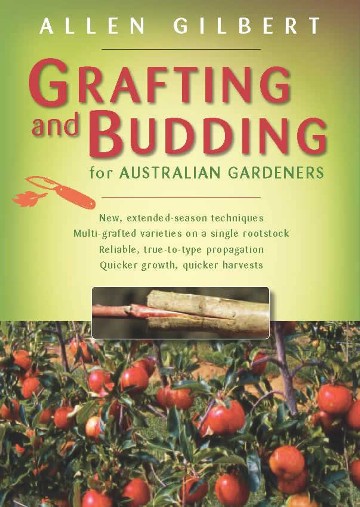
 This new book by dear friend and amazing gardener Allen Gilbert is a bitter sweet publication for me, as Allen died at the end of 2015 just as the book was sent to the printers. To read it now is to have Allen back here telling me all about his latest gardening passion.
Never one to take anything on blind faith, Allen always tested every bit of accepted gardening lore. Grafting and Budding is full of the results of Allen’s experience, and it makes someone like me, who has never attempted either horticultural technique, feel that I might actually be able to bud and graft without messing it up.
Allen was known as ‘Gilby the Grafter’ and as he says in the introduction ‘this book is the culmination of more than 40 years of experimentation and it is intended to stimulate both novice gardeners and experienced hands to find enjoyment and interest in budding and grafting.’
Chapters include Why Graft?, Basic Principles of Grafting, Of Scions and Rootstock, Tools and Hygiene, Grafting and Budding Methods, Special Purpose Grafts and Post-Graft Care.
Among many other things, Allen explains that in Australia plants rarely become completely dormant, and that grafting in Australian conditions is relatively easy. Even beginner gardeners can do it (and I presume long term gardeners like me who have never been game to give it a go). Apparently, except for the coldest regions, most grafting can be done all year round. He also says that it’s important to know if one plant is related to another, and how closely, before you attempt grafting a scion from from one to another. In fact it’s a good idea to keep it within the family, botanically speaking. There is also good information on pruning multi-grafted trees to stop one becoming dominant.
This book is full of this sort of wisdom with excellent diagrams and photographs to illustrate techniques and, as a first for me, also explains how to graft and bud Australian plants, as well as the more common fruits and vegetables. With our gardens becoming smaller, if we want to maintain the diversity of plants we grow, then grafting and budding becomes an essential skill.
In Allen’s words, ‘Any gardener can graft’ and Allen and his book have encouraged me to give it a go. You should too.
By Allen Gilbert, Hyland House Publishing, 2016, flexicover, 144 pages, $29.95
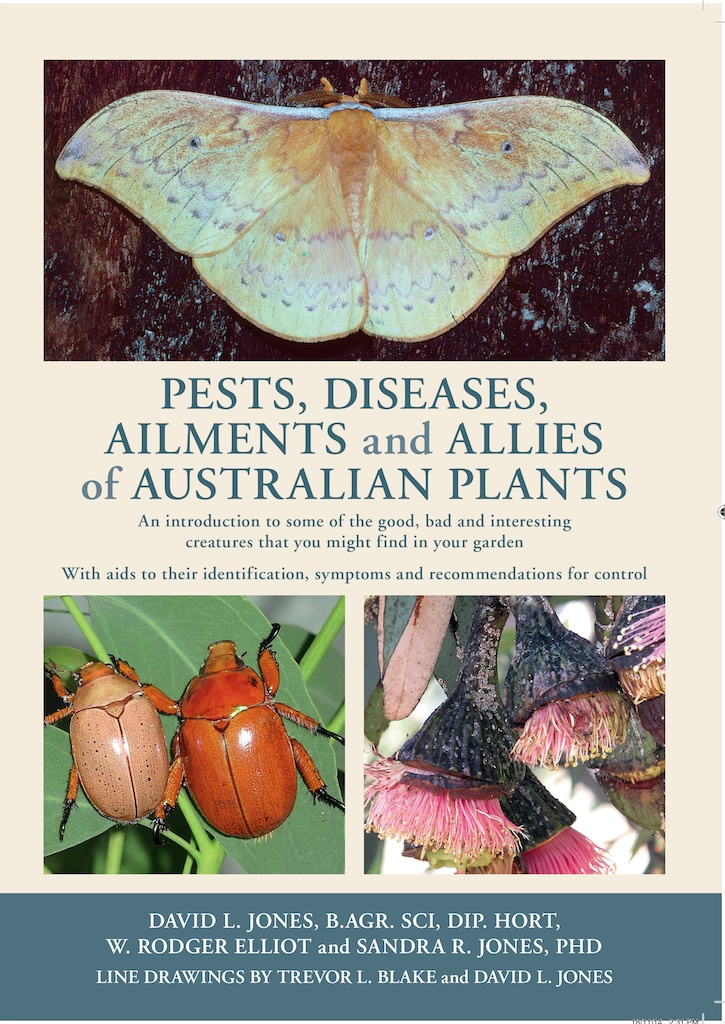 This amazingly comprehensive book is full of beautiful photographs and detailed information about the good and bad bugs and diseases in our gardens. Although focused on Australian plants, many of the insects described are also relevant to exotic species including edible plants. Although chemical and organic approaches to the pests and diseases are given, the authors’ clearly tell us their preferences lie in creating a balanced natural environment, and add that they ‘hope the book assists readers to recognise the wondrous diversity in their gardens.’
In the introduction they also point out that most of the insects and small invertebrates that we find in our gardens are harmless to us and our plants. Accurate identification is essential if we are going to be able to deal with pests in the least harmful way. I will be using the book to learn about what is in my garden and about their life cycles and what, if anything, I need to do. At the very least every gardener should make an effort to become familiar with beneficial insects, so that we are not killing them by mistake.
In the Prelude there are useful starting points on the road to identifying a problem. These are a list of Symptoms and Recognition Features of Pests, Photo Short Cuts, and a Pest Control Table. With its depth of scholarship and knowledge, and wonderful accurate photographs, it is cheap at $45
By David Jones, Rodger Elliot and Sandra Jones, Reed New Holland, 2015, paperback with PVC cover, 448 pages, $45
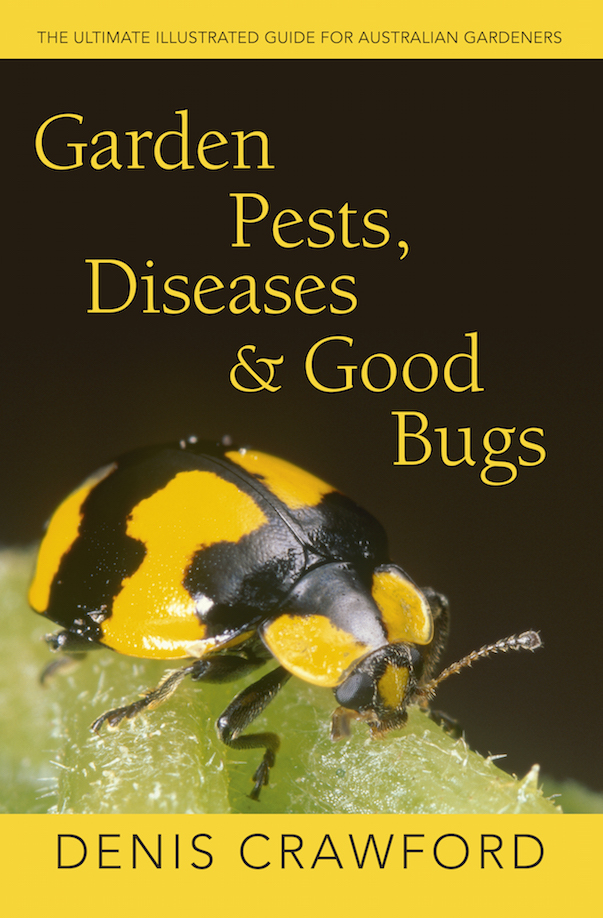 The ultimate illustrated guide for Australian Gardeners
For me, the best part of this book are the photographs. For someone who wanders around gardens, closely inspecting the insects and other micro fauna, as well as the plants, it is wonderful to have a book that I can turn to in an attempt to identify what I am looking at. The text is excellent too, with careful and clear explanations to aid identification, explain life cycles and suggest controls.The three main sections cover Beneficial organisms, Pests, and Diseases, disorders and deficiencies.
There’s also tables near the beginning that list common pests and diseases by plant group. So if something weird is happening to your tomatoes, under Solanaceous plants you’ll find all the pests and diseases that affect this family. Its a bit disheartening that there 45 altogether for just this one group! But it does help to narrow it down and point you to the page and picture to help you work out what it might be. Highly recommended for anyone who loves to garden and wants to understand the other creatures that live in their garden. Denis Crawford has 35 years of experience with this subject and his expertise shines through in the book.
If you want a copy then pick it up at your local independent bookshop, or borrow it from your library.
by Denis Crawford
PB 464pages, ABC Books, HarperCollins Publishers, ISBN 9780733331886 $39.95
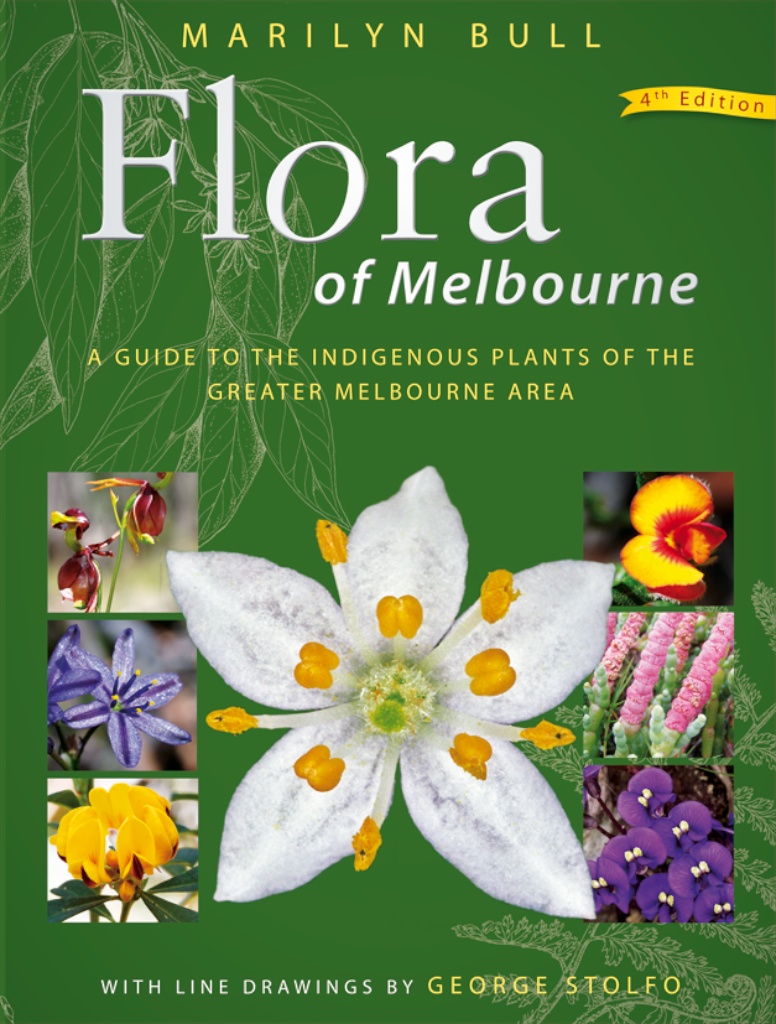
A guide to the indigenous plants of the greater Melbourne area
 Review by Penny Woodward
This is a very impressive book. Not just because of its quality, scholarship and sheer size, but also because of the commitment it has taken, from all the diverse contributors, to get the new edition into print. Covering 1367 plants with beautiful line drawings of each and photographs as well, this 4th edition was 13 years in the making. The first edition was published in 1991 by the Maroondah chapter of the Australian Plants Society and subsequent editions still reflect their input. Author Marilyn Bull worked devotedly on updating, checking, photographing and co-ordinating the book’s contents that not only look at the indigenous (and wild introduced) plants, but also habitat, soils, regeneration, weeds and EVCs (ecological vegetation classes). While this is a catalogue of a specific region, the vast majority of the plants can be found in other parts of Victoria and many in other parts of Australia. Careful and long thought has gone into the design which makes it easy and intuitive to use and the information readily accessible, while the drawings by George Stolfo and photographs make it a pleasure to dip into or study at length. With widespread recognition of the importance of indigenous species in both the bush and our gardens, both for their own sake but also to provide homes and food for indigenous fauna from insects to birds and mammals, Flora of Melbourne is an essential reference. There are also symbols that show which plants attract birds and butterflies. If you don’t want to buy your own copy (although I think the price is very reasonable for the content, size, quality and breadth of information) then get your library to buy one so you can marvel at the scope and beauty of this landmark book.
If you want to buy it then pick it up at your local independent book shop or order it from my online Shop
By Marilyn Bull
Large-format, 624 pp, Hardback ISBN 978 1864471229, RRP $89.95
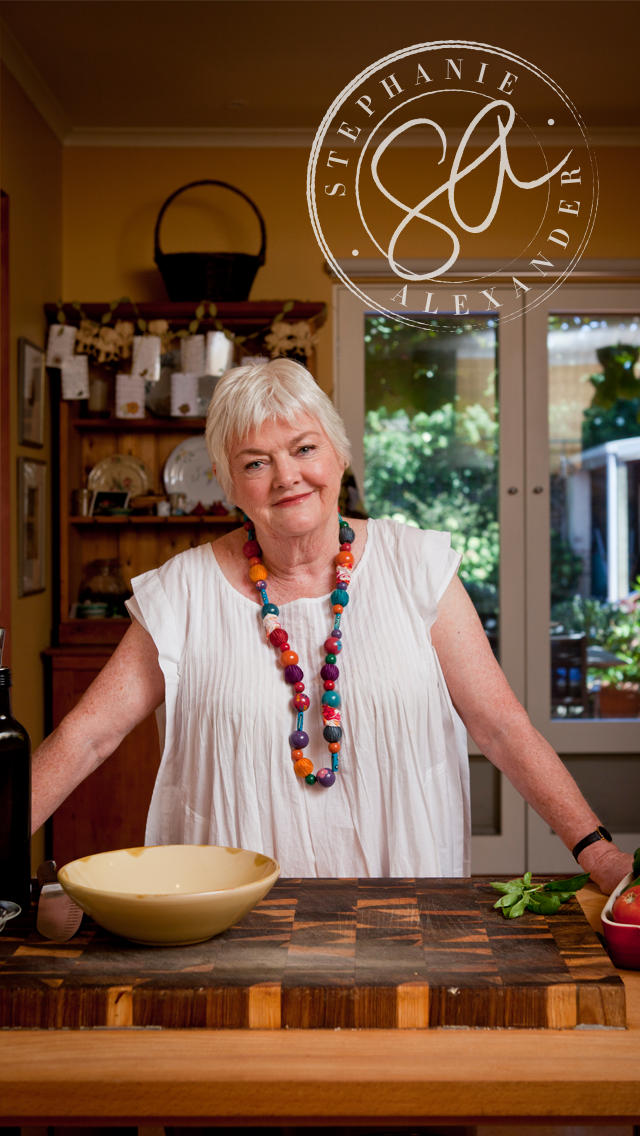
 from Stephanie Alexander and her team and other friends.
Review by Penny Woodward
Stephanie first published her bestselling book The Cooks Companion in in 1996 and since then has sold over half a million copies. Now we have the chance to purchase it as an app. The A-Z form of the book lends itself to the app format and this app is beautifully put together. Fabulous photographs by Simon Griffiths complement the text and recipes. I particularly like the A-Z ingredients. Touch Bananas and you get information about what they go with, where they come from, varieties, seasons, selection, storage, preparation, cooking and six delectable recipes where bananas are the main ingredient. I’m still having fun exploring the app but think I will mostly use the Vegetable and Herbs section, or maybe Fruit and Nuts? But hard to go past Pasta and Noodles or Rices, Grains and Pulses and so much more. Continue Reading
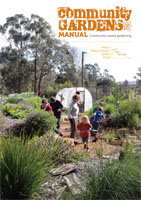
Review by Penny Woodward
This excellent manual is the product of a collaboration between The Helen Macpherson Smith Trust and Sustainable Gardening Australia (SGA). The manual is written by Elaine Shallue and came out of the work undertaken by SGA and local communities to establish community gardens in regions affected by the Black Saturday bushfires. Both the manual and the establishment of the community gardens were funded by The Helen Macpherson Smith Trust.
Elaine describes the sense of community in these regions after the fires. “Individuals took the lead within their communities so that the greatest momentum for renewal came from within. Neighbour helped neighbour, friendships were forged, acquaintances became connected and together the community started to recover. Recognising the strength of this regeneration, communities looked for ways to augment these newly forged bonds. It was in this spirit of community renewal that the Community Based Gardening Project was conceived.’ Continue Reading
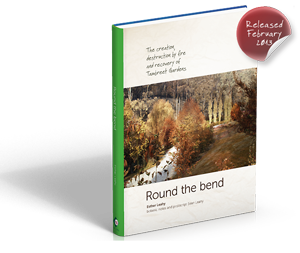 The creation, destruction by fire and recovery of Tambreet Gardens
Review by Penny Woodward
Probably the most interesting gardening book I have read this year, this is the story of a garden created, lost and then recreated. Esther and Sean Leahy moved to the property, a small farm on six acres in 2003 and over the following six years created a garden and retreat. Then on the 7th of February 2009 in the Black Saturday fires, the garden was destroyed, although they managed to save the house. In beautiful prose, Esther describes the process of watching the garden recover and then recreating the garden. I love the descriptions of trees they thought lost, but with great patience they waited, many started to regrow although it sometimes took two years before they could be sure. Some would regrow but then fall victim to winds or pests. Each one feels like a friend. Many of the Australian plants survived by putting out epicormic growth, or reshooting from the ground. But surprisingly many introduced trees recovered too. Oaks, maples, ginkgoes, liquid ambers and coast redwoods being some, although many took three or more years before they were back to their normal cycles. In the end the survivors were pretty much equally divided between native and non-native. They also watched the insects, spiders, reptiles, birds and mammals slowly returning. Some in plague proportions, but eventually the balance was restored. A steady stream of family and friends aided their own long hours of labour, but now, four years later the garden is nearly completely recovered. Continue Reading
 Review by Gail Thomas
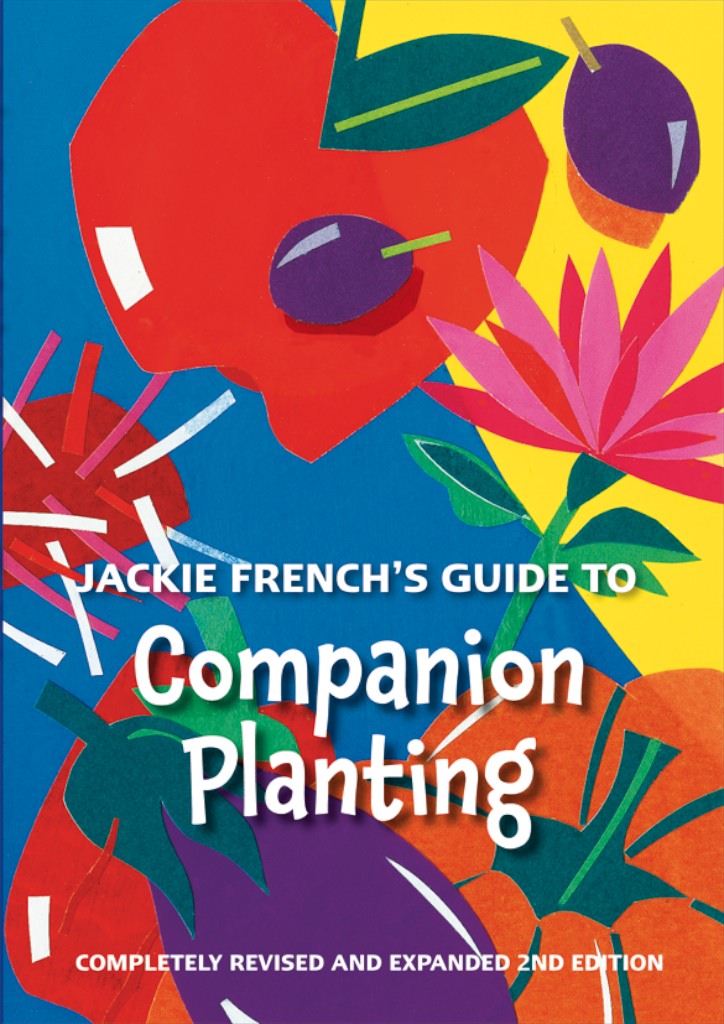
This completely revised and expanded 2nd edition in full colour with chapters on companion planting for fruit, vegetables, flowers, the lawn, and soil fertility explains the effectiveness and how companion planting works along with ways of attracting birds and other pest predators, deterring possum and bruit bats problems and developing your own companion planting.
Whether you’re looking at planting to fix nitrogen in the soil, as companions for your favourite crops or to repel pests Jackie has included plenty of suggestions and rated them accordingly. For example scented leaf geraniums have a high repellent rating, are easy to grow, are highly attractive and can be useful for culinary applications to line cake tins or scent sugar for cooking. As dahlias will outgrow grass she suggests planting an area thickly to clear they area of grass or weeds, and it’s best not to plant daffodils under trees that are under five years old as they will inhibit the tree’s growth.
A diagnostic chart of common pests provides a quick reveal of symptoms, cause and useful companions and a useful list of seed suppliers and books for suggested reading further expand the scope of this best-selling guide.
Borrow it from your libray, buy it from your local independent book shop or buy it online from our Shop
Jackie French, Manna Press, $18.95
Review by Penny Woodward
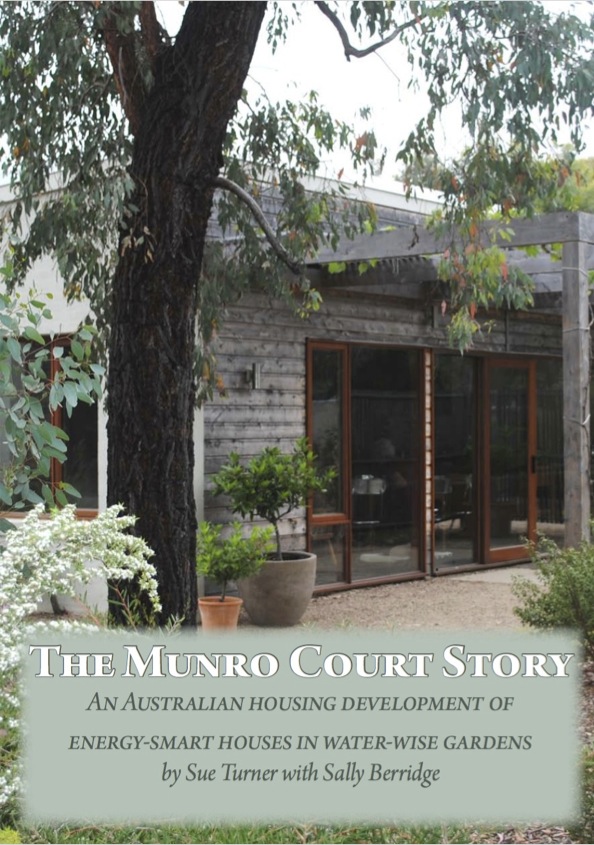 Nestled on the outskirts of Castlemaine, a rural city North West of Melbourne, Victoria; is a small community of people living on their own freehold blocks, in individual houses that are the result of a dream by Sue Turner and Don Wild. Worried about the impact of huge houses on small blocks with few concessions to low energy designs and no room for gardens, Sue and Don wondered what they could do to make a difference. At the same time they noticed that many middle aged friends were contemplating selling their big houses and wanted something more modest and ecologically friendly to move to. Over more than 10 years, Sue and Don purchased a barren block of land with an existing subdivision and transformed it into a thriving community of eight eco-friendly houses with double glazing, fans, solar panels, water tanks and passive solar designs; beautiful landscaped native gardens that provide privacy and habitat; and a communal area for vegetables and chooks. The book, written by Sue Turner with mentoring, editing and photography by Sally Berridge clearly sets out each stage of the vision. It looks at everything from the finances to landscaping and house design, and at the back are useful lists of plants used, books that inspired them, covenants used and even hints on how to deal with a tax audit! Lovely photographs compliment the text as it tells the story of this unassuming couple who have shown us how it is possible, with passion and persistence, to achieve your dreams. While at the same time, in a small way, making the world a better place. To purchase a copy, go to the Turningwild website
By Sue Turner and Sally Berridge, www.turningwild.com.au, $25
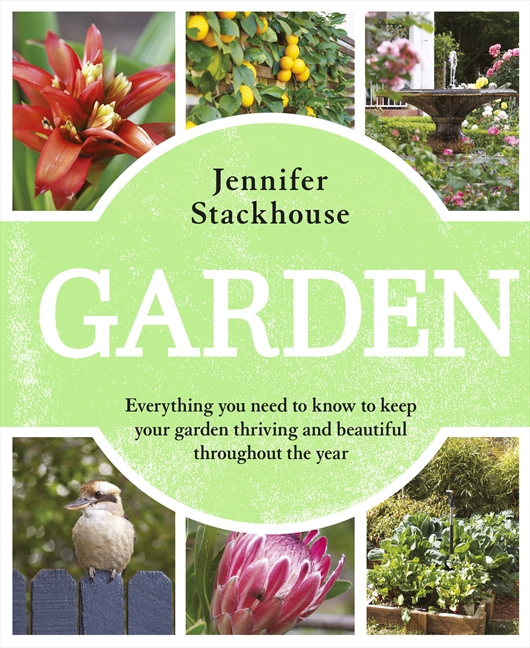 Everything you need to know to keep your garden thriving and beautiful throughout the year
Review by Penny Woodward
Well known garden writer, editor and horticulturalist, Jennifer Stackhouse has written another useful book. Garden covers everything a new and modern gardener needs to know from watering, fertilisers, mulch, compost, pruning, weeding and other maintenance, as well as a calendar of tasks and a list of top plants. There are also instructions for outdoor living that covers pools, ponds, chairs, play equipment and more. Beautiful photographs by Adam Woodhams accompany the text. There is a chapter that looks at how to garden organically and covers all the main topics and my only criticism would be that there is not more of a focus on organics (but then I’m an organic gardener so I would say this!). I particularly like the chapter on troubleshooting which explains useful things like how to tell if a plant is dead or alive, how to protect plants from wind and hail damage, the good and bad effects of frost, and bushfire retardant plants. A great addition to my collection of well researched, easy to use Australian gardening books.
By Jennifer Stackhouse, ABC books published by Harper Collins Australia, 2013, $35
(The book was given to me by the publishers)
Recent Topics
fruit gardening Gail Thomas Penny Woodward tomatoes garden herb salad seeds vegetable herbs pests vegetables organic garlic autumn recipes medicinal carrots rosemary cooking snails slugs Woodward pest-repellent plants zucchini berries artichoke compost chamomile apples squash Diggers bay comfrey