Know your onions (and shallots)

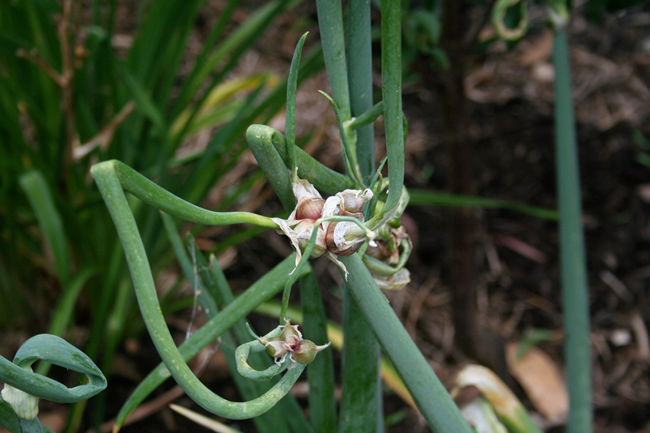
The small bulbils that form on the top of tree onions, also known as walking onions

Tree onions produce bulbils instead of flowers. The bulbils sprout so that the plant looks like a small tree.

In the early 1900′s the American writer O. Henry wrote that “A stew without onion is worse’n a matinée without candy” and I’m sure that  chefs all over the world would agree with him. Cooks and gardeners are familiar with the common bulb onion (Allium cepa), different cultivars of which provide a range of oniony flavours but what about the other onions: shallots and the ever-ready, potato and tree onions? When Jonathan Swift wrote in 1700
“But lest your kissing should be spoil’d,
Your onions must be thorough boil’d”
he was probably talking about these alternate onions which have been grown and valued by gardeners for centuries. They are usually propagated from bulbs which multiply to form more bulbs, rather than by planting seed. They are also disease and pest resistant making these onions much easier to grow than common bulb onions. Read more
Autumn colours, mosses, lichens and toadstools

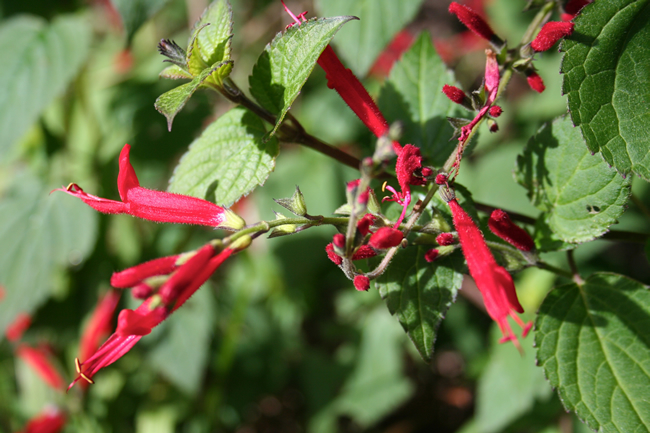
Pineapple sage, Salvia elegans 'Honeymelon'

Pineapple sage attracts spinebills and honeyeaters into the garden

At this time of year articles begin to proliferate describing plants you can grow that will lend splashes of colour to sombre autumn and winter days. As usual I am gaining much pleasure from the bright red flowers of pineapple sage (Salvia elegans). So too are the eastern spinebills who flash their tawny throats at me as they fossick for nectar. Also dog’s bane (so named because it’s ability to repel some dogs), Plectranthus ornatus, has been sporting its strong, mauve flowers for months now and will continue to do so right through winter. Really for me the colour highlights in late autumn and winter come from all the plants I haven’t planted, the ones that turn up whether you want them or not.
Read more

  • All words and images © Copyright Penny Woodward 2026.
  • Back to Top ↑